Telecommunications enclosure manufacturing
Custom Telecommunications Enclosures for Network Equipment
From compact fiber distribution boxes to large outdoor cabinet and equipment-housing assemblies, we manufacture custom sheet metal enclosures for telecom integrators and OEMs. Our in-house capabilities span laser cutting, forming, hardware insertion, welding, finishing, and powder coating.
We support lightweight aluminum housings, designs intended for challenging temperature conditions, and one-stop OEM and private-label production—reviewed against your drawings, specifications, and validation requirements.
Typical batches: 10–500 units, with recurring supply programs supported.
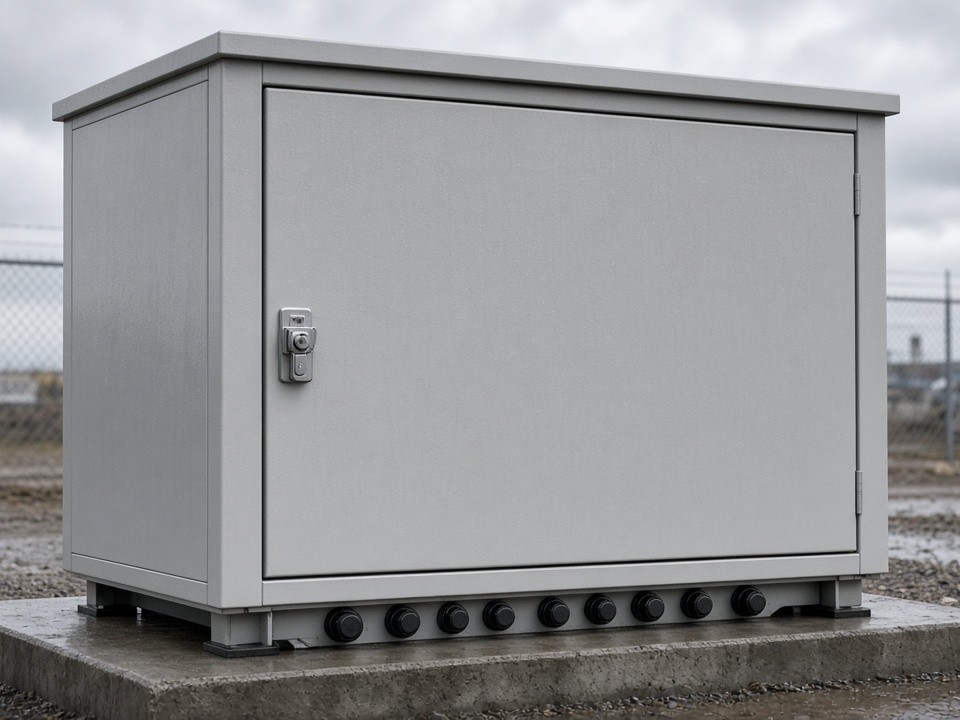
A broad manufacturing range, under one roof
Compact fiber boxes, outdoor cabinets, structural frames, and large equipment housings—all coordinated across fabrication and finishing.
10–500
Typical units per batch
2,000 × 6,000 mm
Heavy-duty assembly platform dimensions
50 / 6
Organization team members / dedicated QA/QC specialists
Built around your equipment
Enclosures shaped by the application
The right enclosure fits the installed hardware, cable routing, service access, and deployment environment—not just the outside dimensions. We work from customer drawings, 3D models, or an initial project brief.
Discuss your enclosure projectFiber and network equipment
Fiber distribution and termination boxes, base station equipment housings, and network infrastructure cabinets.
Outdoor and roadside applications
Outdoor utility and communications cabinets, traffic monitoring enclosures, and roadside control housings.
Parts, assemblies, and large-format builds
Custom brackets, mounting panels, doors, and structural frames, from compact sheet metal parts to large equipment housings. Six-meter fabrication platforms support setup and structural welding; an in-house 2,500 × 6,000 mm powder coating line processes oversized parts within its envelope. Container-style base station housings are assessed by actual dimensions, construction, and shipping configuration; a standard shipping container is not implied.
Integrated sheet metal production
In-house processes, fewer handoffs
Keeping fabrication and finishing under one roof helps us coordinate parts, assemblies, and finishes throughout production without relying on external coating subcontractors.
01 / CUT
Fiber laser cutting
Three machines, including 12 kW and 6 kW sources, for sheet metal profiling.
02 / FORM
CNC press-brake forming
Five machines across multiple tonnage ranges for compact chassis and larger cabinet panels.
03 / PREPARE
Hardware insertion and tapping
Automated clinching and servo tapping for PEM fasteners, studs, standoffs, and threaded holes.
04 / JOIN
Laser, MIG, and TIG welding
Processes selected to suit the joint, material, strength requirements, and appearance.
05 / FINISH
Surface preparation and coating
Deburring, stainless steel brushing, and in-house powder coating.
06 / ASSEMBLE
Assembly and heavy handling
Large reference tables and a 3-ton forklift support fabrication and movement of heavy assemblies.
Materials and outdoor design
Select construction for the real service conditions
Steel is a practical choice for many cabinets and larger housings where rigidity and fabrication flexibility matter. Aluminum can reduce weight where mass is a design priority. We also process stainless steel. Material and thickness should be selected against dimensions, mounting method, loads, joining approach, finish, and service conditions.
Outdoor equipment may face wide temperature changes, moisture, UV exposure, and installation-specific corrosion risks. Performance and environmental ratings depend on the complete design, sealing details, components, and validation plan; we do not assume an IP or NEMA rating that has not been specified and validated.
Include these details in your RFQ
- Operating and storage temperature ranges and installation location
- Required IP or NEMA targets and verification criteria
- Cable entry locations, door and gasket interfaces, and mounting orientation
- Exposure conditions, finish requirements, and sealing approach
These inputs help us review the fabrication scope against your requirements. Environmental qualification should be confirmed through the project’s defined testing and validation process.
Engineering and quality
Designed for fit and repeatability
Five mechanical and manufacturing engineers review manufacturability, sheet metal unfolding, bend allowances, and structural details. Early review can identify bend interference, difficult fastener access, or unclear interface dimensions before production.
Engineering review can cover
- Panel layouts, door openings, and mounting interfaces
- Bend lines, reliefs, and assembly clearances
- Hardware locations and installation access
- Welded joints and potential cosmetic distortion
- Part nesting and production consistency
Provide the latest drawing revision and critical dimensions or GD&T requirements. For designs in progress, a 3D model and application notes are a useful starting point.
Quality checks through production
Our 50-person organization includes six dedicated QA/QC specialists. Quality control extends through incoming material verification, production-stage checks, first-article inspection, and pre-shipment inspection.
Inspection requirements follow the drawing, order, and agreed quality plan. Specify material records, dimensional reports, finish criteria, or other documentation in your RFQ.
OEM and private-label support
A manufacturing scope that fits your project stage
We support customer-specific parts, assemblies, and finishes for telecom equipment integrators. Private-label details such as approved markings, labels, packaging, and product identification can be reviewed as part of the production scope.
Production-ready design
Quote from current files
Send 2D drawings, 3D CAD files, material and finish specifications, and target quantities for fabrication review and quotation.
Design in development
Start with the application
Share intended equipment, installation environment, approximate dimensions, and key interfaces so engineering can review manufacturability and open questions.
Recurring supply
Plan repeat orders
Include annual demand, batch size, forecast assumptions, revision-control needs, and delivery expectations to support production planning.
Private-label order details
Provide branding artwork or marking specifications, placement, production quantity, packaging requirements, and any restrictions on component or product identification. We will confirm what can be incorporated into the enclosure and production workflow.
Request a telecommunications enclosure RFQ
Send your drawings or project requirements
Our team will review the information, clarify open technical points, and respond with a manufacturing quotation. If your design is at an earlier stage, contact us with the application brief and current concept.
Help us quote accurately
- 2D drawings and 3D CAD files, if available
- Material, thickness, and finish requirements
- Enclosure dimensions and critical tolerances
- Quantity and expected annual volume
- Cable, mounting, hardware, and assembly details
- Outdoor conditions and specified IP or NEMA targets
- Inspection, documentation, packaging, and private-label requirements
- Target delivery date and shipping destination