Custom sheet metal enclosures
Custom IP45 Enclosures for Ventilated Industrial Equipment
Enclosuremfg manufactures custom enclosures for equipment that needs protection from small solid objects and water jets while maintaining airflow for heat dissipation. We support electrical power workshops and low-dust industrial environments.
Our engineers can review your enclosure layout, ventilation requirements, mounting details, and protection target before production. In-house fabrication covers laser cutting, CNC bending, hardware insertion, welding, finishing, and powder coating.
Send drawings, target quantity, and operating conditions for a quotation.
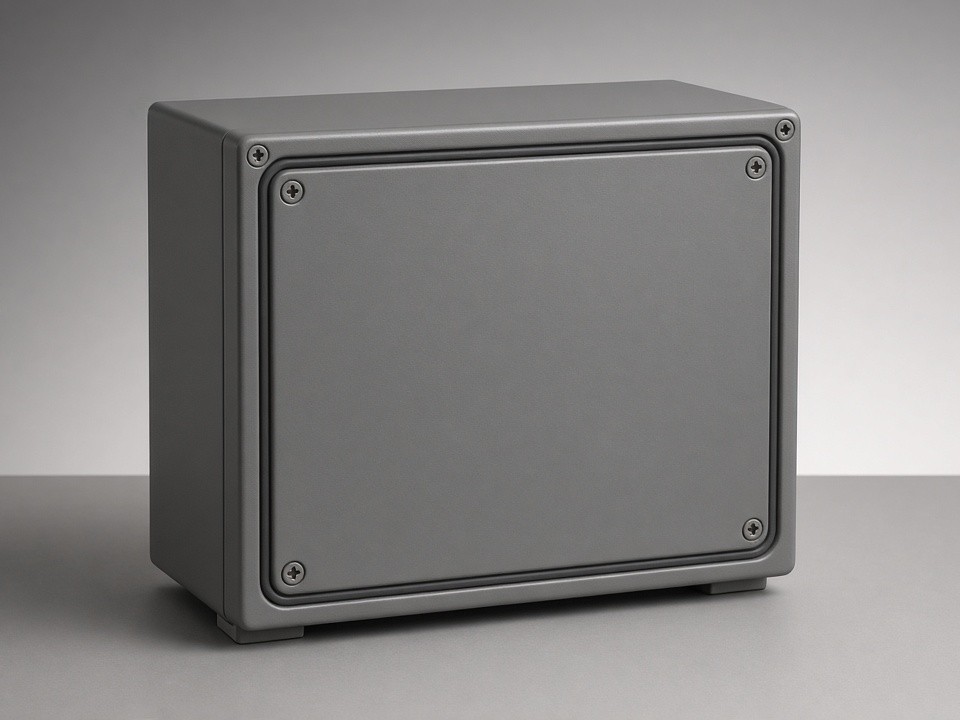
Mesh integration is reviewed as part of the complete enclosure design—not as standalone proof of an IP rating.
Protection fundamentals
What IP45 means for your enclosure
IP45 combines protection against access and larger solid objects with protection against water projected by a nozzle under specified test conditions.
First digit · IP4X
Small solid-object protection
Protection against access to hazardous parts with a wire and against solid foreign objects 1 mm or larger.
Second digit · IPX5
Water-jet protection
Protection against water projected by a nozzle from any direction under the defined test conditions.
The rating applies to the completed assembly
Openings, joints, doors, cable entries, installed components, and the test method all affect the result. Mesh opening size, mounting, perimeter coverage, and relationship to the enclosure must be evaluated. Mesh alone does not establish IP45 compliance.
IP45 may suit ventilated equipment that does not require dust ingress or immersion protection. Tell us if the site involves fine dust, strong washdown, outdoor exposure, or other demanding conditions so we can review the protection target.
Ventilation by design
Balance airflow with practical ingress protection
Fine mesh and perforated panels can help block larger solid objects while supporting convection and heat dissipation. The right configuration depends on the equipment, installation location, heat load, and required test conditions.
Mesh and openings
Review opening size and panel placement in relation to the risk of fine metal wire intrusion.
Airflow path
Consider ventilation area and airflow around heat-generating components.
Panel integration
Plan panel attachment, edge coverage, maintenance access, and internal clearances.
Water exposure
Evaluate water exposure against the complete enclosure and specified acceptance method.
We review these details with your engineering team rather than treating a mesh specification as proof of IP45 compliance.
In-house manufacturing
Fabrication under one roof
A 50-person team includes five mechanical and manufacturing engineers and six QA/QC specialists. Engineering and quality personnel account for more than 20% of the organization.
Fiber laser cutting
Three machines, including 12 kW and 6 kW laser sources, for profiling sheet metal parts.
CNC press-brake forming
Five machines across multiple tonnages for compact cabinets and larger structures.
Hardware insertion and tapping
Automated clinching, servo tapping, and drilling-tapping for PEM nuts, studs, standoffs, and threaded features.
Welding and assembly
MIG, TIG, laser, and cold-welding equipment, with assembly platforms up to 2,000 × 6,000 mm.
Surface finishing
Stainless steel brushing and weld blending where specified.
In-house powder coating
Pretreatment, spraying, and curing on a 2,500 × 6,000 mm line.
In-house operations help coordinate fabrication, finishing, and assembly without separate coating or fabrication subcontractors. Equipment supports projects from compact electrical boxes to large machinery housings and frames.
Engineering and quality
Design review, inspection, and production support
Before fabrication, our engineers can review 2D drawings and 3D CAD data for manufacturability, including bend allowances, formed-part clearances, weld access, hardware locations, mesh integration, and assembly interfaces.
Quality checks can include incoming material verification, in-process checks, first-article inspection, and pre-shipment inspection. Inspection requirements and records can be discussed during quotation to align with your drawings and purchasing specifications.
Define the acceptance requirements
For an IP45 project, identify the required test standard or method, if specified. The protection rating applies to the completed enclosure assembly under defined conditions—not an individual panel, mesh, or component.
If formal validation is required, we can coordinate manufacturing details against your stated acceptance requirements.
Discuss your test requirementsApplication fit
Is an IP45 enclosure suitable for your application?
An IP45 design may be worth evaluating when equipment needs ventilation and protection from small solid objects and water jets, but does not require dust-tight or immersion protection.
Typical contexts include electrical power workshops, indoor industrial equipment, and low-dust production areas.
When should we review a different protection strategy?+
Consider additional or different protection if the enclosure faces fine airborne dust or conductive particulate, high-pressure cleaning or frequent intensive washdown, outdoor weather, standing water, or immersion.
What thermal information should we provide?+
Share the equipment heat load and airflow conditions. Temperature or airflow requirements may call for a defined thermal-management solution.
What should be reviewed before production?+
We can assess fabrication implications and flag enclosure, mesh, access, mounting, or acceptance details that need clarification before production.
Request a quotation
Tell us about your IP45 enclosure project
Share your installation conditions and equipment heat load. Our team can review fabrication requirements and discuss your specified acceptance criteria.
Helpful project information
- 2D drawings and, if available, 3D CAD files.
- Target dimensions, material, thickness, and finish.
- Required mesh or perforation details and ventilation needs.
- Specified IP45 test or acceptance requirements.
- Annual demand, initial batch quantity, and delivery location.
We support high-mix, low-to-medium-volume production, with typical batches of 10 to 500 units and recurring supply programs.