Custom sheet metal manufacturing
Custom IP67 Enclosure Fabrication
Need an enclosure designed to resist dust and temporary water immersion? Enclosuremfg manufactures custom sheet metal housings for industrial equipment, outdoor power systems, field automation and sensor assemblies.
Laser cutting, CNC bending, hardware insertion, welding and powder coating are coordinated in one facility. Share your environment and acceptance criteria so we can review manufacturability and define a suitable production and validation plan.
IP67 is a protection rating for the complete assembled enclosure—not a material or fabrication process.
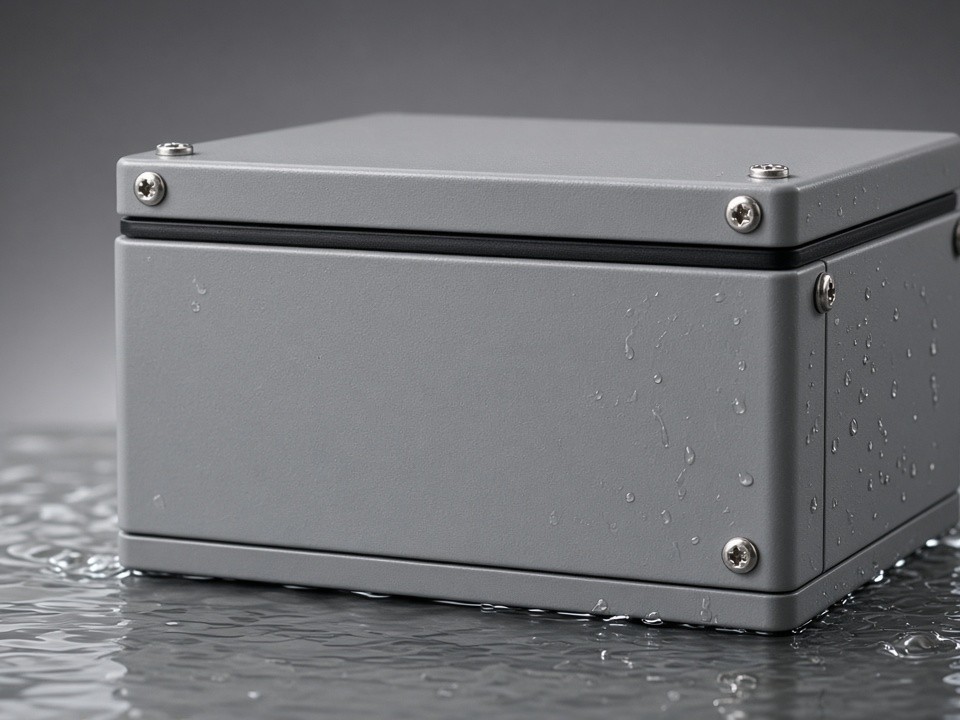
Design around the full assembly
Doors, gaskets, fasteners, cable entries and interfaces all influence ingress protection. Define the delivered configuration and test conditions before design freeze.
Rating and requirements
What an IP67 enclosure requires
Dust and temporary immersion
Under IEC 60529, IP6X addresses dust ingress and IPX7 addresses temporary immersion under defined test conditions. The standard immersion test is generally associated with up to 1 meter of water for 30 minutes; confirm the applicable setup and acceptance criteria for your product.
The whole configuration matters
Potential leak paths include panel joints, doors, removable covers, cable glands, connectors and mounting interfaces. A welded shell alone does not establish an IP rating.
For low-lying outdoor equipment and sensor assemblies
Tell us the actual water depth, duration, orientation and operating state. If your requirement involves brief complete immersion at 1 meter, treat it as a defined project condition—not an automatic performance claim. Underwater operating requirements may extend beyond an IP67 designation.
Integrated production
A connected fabrication route, managed in-house
Key fabrication and finishing steps take place under one roof, helping teams coordinate revisions, handoffs and inspection through one manufacturing source.
3
Fiber laser machines
Including 12 kW and 6 kW sources for sheet metal profiling.
5
CNC press brakes
OG35 (2), OG100 (2) and OG200 (1) for varied forming needs.
24
Welding units
Laser, MIG, TIG and cold-welding equipment.
2,500 × 6,000 mm
Powder coating line
In-house finishing; confirm fit and finish requirements.
Hardware and machining
Seven machines support hardware insertion, drilling and tapping.
Assembly platforms
18 sets, including 2,000 × 4,000 mm and 2,000 × 6,000 mm platforms for fixture setup and larger assemblies.
Engineering and quality
50 personnel, including 5 engineers and 6 QA/QC specialists.
Material, thickness, tolerances, coating specification and maximum part dimensions depend on the drawing and project requirements. Include these details in your RFQ for a manufacturability and capacity review.
Sealing-focused fabrication
Welded bodies, sealing flanges and immersion requirements
A high-tightness enclosure begins with geometry that can be fabricated and assembled consistently. Our engineering review can consider panel layout, bend sequence, joint access, sealing interfaces and potential weld distortion.
Plan flange and mating details
For welded bodies with thicker sealing flanges, provide flange dimensions, mating-face requirements, gasket type and closure method. We can review suitability for forming, welding and assembly, and discuss the inspection or validation approach requested.
Specify any pressure-hold test
If your project calls for negative-pressure evacuation, hold-time measurement or a particular leak limit, include the method and acceptance criteria in the RFQ. We will confirm whether the requested setup can be supported and agree on the method before production or testing is scheduled.
A pressure-hold check does not replace the applicable IP test unless your specification explicitly defines it as an accepted validation method. Welded seams or a vacuum test alone do not establish IP67 certification.
Engineering and quality checks
Our engineering team reviews manufacturability details including unfolding, bend allowances, structural features and assembly interfaces. Early review can help uncover issues before they lead to rework, fit problems or delayed first articles.
Quality through production
Six full-time QA/QC specialists support incoming material checks, in-process inspections, first-article review and pre-shipment inspection. The inspection plan depends on your drawings, purchase order and quality requirements.
Identify critical dimensions, cosmetic zones, traceability needs and required records when requesting a quote. For immersion projects, validation should match the complete delivered assembly: a change to a door, gasket, gland or connector can affect sealing performance.
Application planning
Select the right build for your project
Typical work includes high-mix, low-to-medium-volume production, often in batches of 10 to 500 units, as well as recurring supply programs. The route depends on enclosure size, environment, assembly method and volume.
Outdoor electrical cabinets and power equipment
Provide the required ingress rating, mounting arrangement, cable-entry locations, finish and exposure conditions.
Low-lying outdoor equipment
Specify expected water depth and duration, including whether temporary immersion at 1 meter is required.
Underwater sensor assemblies
Share operating depth, service duration, connector details and whether the enclosure must function while submerged.
Machine covers and operator consoles
Include access-panel details, hardware locations, surface-finish expectations and machine-frame interfaces.
Large-format equipment housings
Send overall dimensions, assembly drawings and lifting or transport constraints for platform and coating-line fit review.
Define the assembled product
Set the required rating and test conditions for the full assembly before design freeze, so quotes share a consistent scope.
Start your project
Request an IP67 enclosure RFQ
Send your drawing or 3D model for a manufacturing review and quotation. We will review fabrication details, identify points that need clarification and confirm the proposed scope before quoting.
Include these details in your request
- Part drawings or 3D CAD files, with material and thickness.
- Annual demand, initial batch quantity and expected release schedule.
- Required IP rating and test standard or acceptance criteria.
- Door, gasket, fastener, gland and connector details.
- For immersion, water depth, duration, orientation and operating state.
- Any negative-pressure evacuation or pressure-hold method and acceptance limit.
- Finish, color, critical dimensions and inspection documentation requirements.