Custom outdoor enclosures
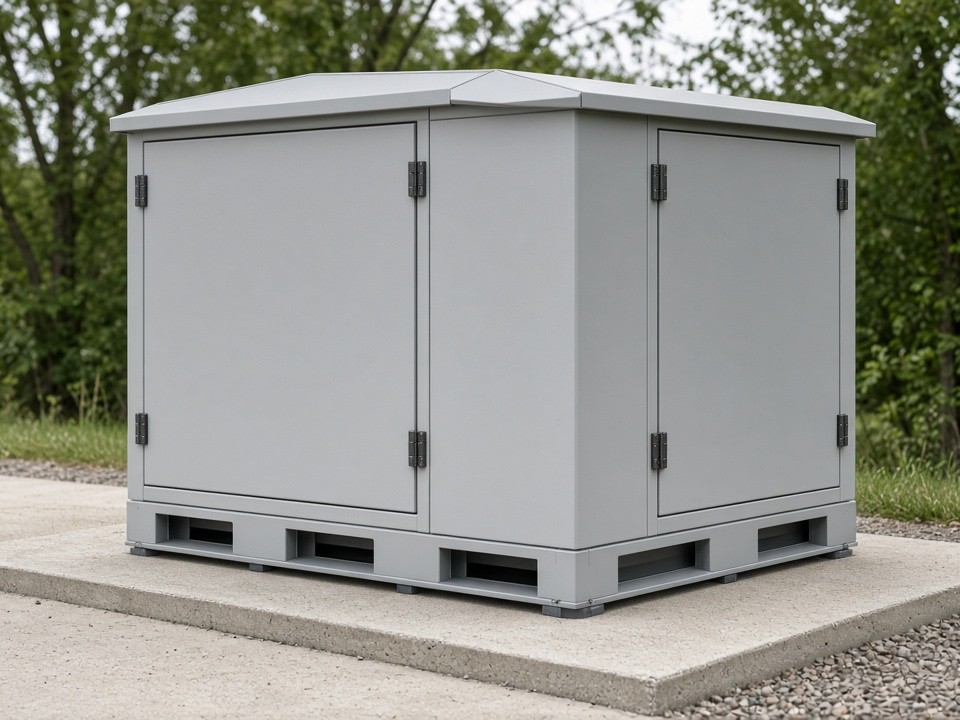
Pad Mount Enclosures for Utility and Energy Projects
Custom sheet-metal enclosures for outdoor transformers, power distribution systems, battery infrastructure, and high-power EV charging installations—built around your equipment and concrete-pad interface.
- 01Open-bottom base and mounting flange coordinated with your pad and sealing details
- 02Optional bottom mesh to help deter small-animal entry
- 03Optional polyurethane foam base lining for condensation-control designs
One fabrication route, from drawing review to finish
In-house laser cutting, forming, hardware insertion, welding, assembly, and powder coating help keep project details coordinated.
50
People across engineering, production, and quality
5
Mechanical and manufacturing engineers
6
QA/QC specialists
10–500
Typical custom batch range
Built around the site interface
Designed to meet the concrete pad—and the equipment inside
Base openings, anchor patterns, flange geometry, and sealing surfaces need to align with site civil works and installation methods. We review these interfaces against your drawings before production.
We manufacture to approved drawings. Final compliance with municipal, utility, electrical, and civil requirements must be confirmed by the project owner or responsible design authority.
Open-bottom flange
Base opening and mounting flange designed around the concrete pad, anchor layout, and specified sealing interface.
Sealing surfaces
Flange geometry can be coordinated with customer-defined gasket, sealant, or civil-interface requirements.
Bottom animal barrier
Optional mesh helps deter small animals from climbing into the enclosure, subject to airflow, access, and protection needs.
Condensation-control layer
Polyurethane foam at the enclosure base can be included where the design specifies its location, thickness, and coverage.
Anchor and cable-entry coordination
Locations can be laid out to match approved drawings, cable routing, equipment clearances, and the planned installation sequence.
In-house production
One fabrication route for the enclosure assembly
Keeping core processes under one roof reduces handoffs and helps maintain control of dimensions, revisions, surface preparation, and coating instructions.
| Capability | In-house equipment or capacity | Project benefit |
|---|---|---|
| Laser profiling | Three fiber laser machines, including 12 kW and 6 kW sources | Accurate profiles for panels, openings, and mounting features |
| CNC bending | Five CNC press brakes: OG35, OG100, and OG200 models | Forming capacity for panels and heavier structural parts |
| Hardware insertion | Seven clinching, tapping, and drilling-tapping machines | Repeatable specified PEM nuts, studs, and threaded features |
| Welding | 24 laser, MIG, TIG, and cold-welding units | Process options for structural and cosmetic requirements |
| Assembly fixturing | 18 heavy-duty platforms, up to 2,000 × 6,000 mm | Support for large assemblies and longer structural parts |
| Powder coating | In-house 2,500 × 6,000 mm coating and curing line | Large enclosures can be finished without an external coater |
| Material handling | 3-ton forklift | Internal movement of heavy parts and assemblies |
Design details we review before production
Engineering review can identify production or interface questions before parts are released, helping reduce avoidable rework and fit issues at installation.
Formed geometry and assembly fit +
Review bend allowances and panel relationships to reduce interference when doors, covers, and adjoining sections are assembled.
Welds, flange, and mounting layout +
Consider suitable weld processes and sequences, dimensional requirements, and the approved concrete-pad and anchor information.
Hardware, service access, and finish +
Check fasteners, openings, equipment access, coating coverage, masking, and surface-finish expectations before fabrication.
Prepare your RFQ
Give us the details that define your build
Final material, gauge, tolerances, coating system, and protection level should follow your project specification. Share revision-controlled drawings and identify critical-to-quality dimensions.
Typical support includes custom, high-mix, low-to-medium-volume production and recurring programs. Lead time depends on drawing readiness, material availability, finishing requirements, and quantity.
Equipment and dimensions
Application, overall width, height and depth, oversized or split-panel needs, equipment clearances, and cable routing.
Pad interface and base protection
Concrete-pad dimensions, anchors, flange and sealing method, mesh material and aperture, attachment, and access needs.
Materials and condensation control
Material grade and thickness, polyurethane foam location, thickness, coverage, and any performance criteria.
Openings, hardware, and finish
Ventilation, doors, hinges, locks, PEM hardware, lifting points, powder-coat color, texture, pretreatment, and masking.
Quantity, schedule, and quality requirements
Prototype or production volume, destination, target dates, tolerances, inspection points, documentation, and applicable standards. The coating line handles parts up to 2,500 × 6,000 mm; larger assemblies may need a review of part breakdown, handling, and finishing sequence. Stainless-steel brushing and weld-bead blending are also available where specified.
Quality checks from material receipt to shipment
Six full-time QA/QC specialists support material verification, in-process checks, first-article review, and pre-shipment inspection. The control plan can be aligned with your drawings and purchase requirements.
- Overall dimensions and panel geometry
- Base opening, flange dimensions, and anchor-hole locations
- Door fit, hardware position, and access clearances
- Weld condition and assembly alignment
- Coating appearance and specified finish details
- Mesh and insulation features in the approved design
Inspection scope, records, sampling rules, and acceptance criteria should be agreed during quotation. Include project-specific reporting requirements with your RFQ.
Have a pad mount enclosure project to review?
Send drawings, 3D files, or a preliminary layout. Include the pad interface, base mesh and foam details, finish, quantity, destination, and required documentation.
Request a quotation
Start with your drawings and project requirements
Our team can review the package for manufacturability, identify open questions, and prepare a quotation based on the approved scope.
Contact Enclosuremfg at info@enclosuremfg.com. Company address: Building 4, Kuiqing Road, Qingxi Town, Dongguan City, Guangdong Province.