Custom sheet metal enclosures
Custom Electrical Meter Box Fabrication
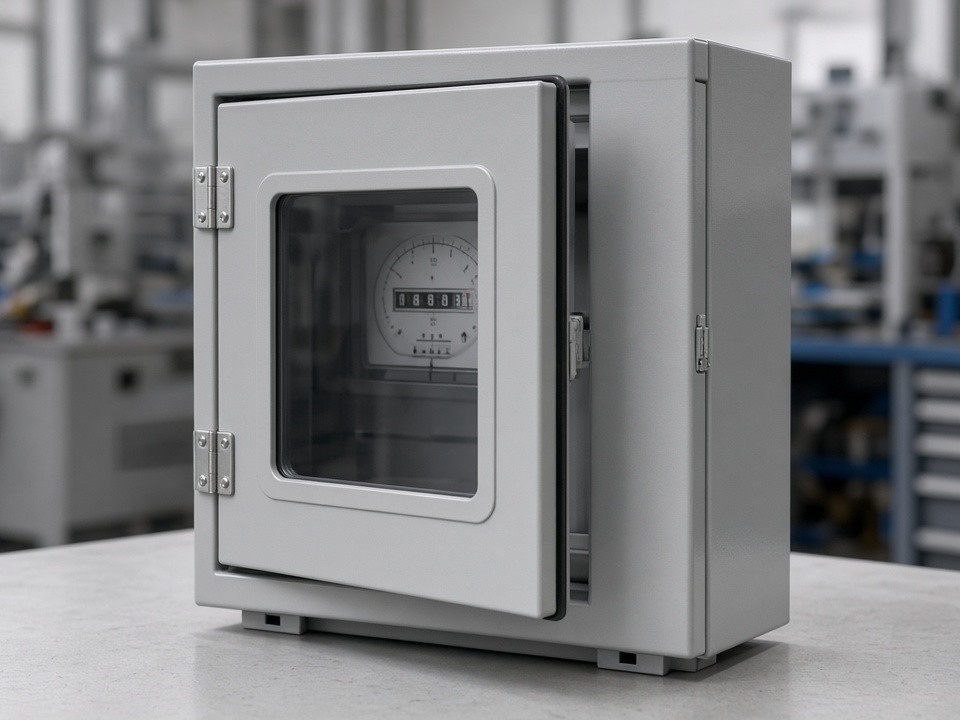
For utility metering and sub-metering projects, the enclosure must protect electrical components while keeping readings visible and installation straightforward. At Enclosuremfg, we manufacture custom sheet metal electrical meter boxes for utility suppliers, electrical equipment OEMs, and infrastructure integrators.
Our engineers review your drawings and application requirements before production. Specify an integrated clear PC viewing window, cable-lock or tamper-seal holes, standardized DIN rail mounting, and your required enclosure protection target.
50
person operation
5
mechanical and manufacturing engineers
6
QA/QC specialists
Built around your assembly
Design details that support safe, readable metering
Visibility, access control, mounting, and environmental protection all depend on the meter, installation location, wiring layout, and project standards.
Integrated clear PC window
A seamlessly integrated, transparent polycarbonate viewing window lets readings be checked without opening the enclosure. Define visibility, impact resistance, scratch resistance, exposure conditions, retention, and sealing requirements for review.
Tamper-evident provisions
Cable-lock or seal holes can be coordinated with the door, cover, or latch to support utility inspection and discourage unauthorized access. Hole dimensions and locations follow your seal hardware and drawings.
Standardized DIN rail mounting
Rail type, position, length, and fixing method are coordinated with the meter and associated components, including installation and wiring clearances.
Protection designed as a system
Door seams, gaskets, cable entries, and window interfaces all affect ingress protection. We review the complete design against your target IP rating; the rating must be verified using the appropriate testing and is not inferred from fabrication alone.
Important application note
A clear PC window is not, by itself, an explosion-proof feature. For hazardous-area use, provide the required certification and design standard so the enclosure can be assessed accordingly.
In-house capability
Fabrication capacity for meter box programs
We produce sheet metal parts and assemblies in-house, helping customers coordinate production steps through one manufacturing source. Engineering and quality personnel support projects from drawing review through inspection.
| Process or resource | Capacity | Customer benefit |
|---|---|---|
| Fiber laser cutting | Three machines, including 12 kW and 6 kW systems | Accurate profiles for doors, cutouts, cable entries, and mounting patterns |
| CNC press-brake forming | Five machines: OG35, OG100, and OG200 models | Repeatable formed panels and box sections across different part sizes |
| Hardware insertion and tapping | Seven machines for clinching, drilling, and tapping | Consistent threaded studs, nuts, and component mounting features |
| Welding | 24 laser, MIG, TIG, and cold-welding units | Process options for structural joints and appearance-sensitive assemblies |
| Assembly platforms | 18 platforms, up to 2,000 × 6,000 mm | Stable fixture setup for larger cabinets and assemblies |
| Powder coating | In-house 2,500 × 6,000 mm coating line | Coating and curing handled within our facility |
| Material handling | One 3-ton forklift | Safe movement of heavy assemblies through production and loading |
In-house processing reduces handoffs between separate fabricators, coaters, and assemblers. For recurring meter-box orders, fewer external steps can make production coordination and revision control more straightforward.
Engineering review
Coordinate the window, seal, and mounting with your assembly
We can work from customer CAD files, drawings, or a defined specification to align enclosure details with the components they must contain. Engineers review unfolding, bend allowances, clearances, and assembly interfaces to help identify interference before batch fabrication.
- 01Meter dimensions, connector positions, quantity, and required reading area
- 02PC window aperture, material requirements, finish, retention, and sealing method
- 03Cable-lock or tamper-seal type, hole dimensions, and placement
- 04DIN rail type, length, position, fixing method, and wiring clearance
- 05Cable entries, gland sizes, access, hinges, latches, and fastening requirements
- 06Material, finish, environmental exposure, and target protection rating
Select processes to suit the project
Laser cutting and CNC bending
Laser cutting suits repeatable panel profiles, window openings, and mounting patterns. CNC bending forms bodies, doors, and internal brackets, with bend allowances and reliefs reviewed for assembly.
Clinching, tapping, and welding
Attachment points support DIN rails and internal plates. Welding is chosen to suit joint function and appearance; low-heat laser welding is available where minimizing cosmetic distortion matters, alongside MIG and TIG for suitable assemblies.
Powder coating
Our in-house line supports coordinated coating and curing. Match coating specification and pretreatment to the intended environment and project requirements.
If IP rating, corrosion performance, or impact resistance is essential, include the applicable test method or standard in your RFQ. Compliance depends on the agreed design and verification method.
Quality and project planning
Quality checks from drawing review to shipment
A mounting hole, bend, or window-interface issue discovered late can delay a meter-box program. Engineering supports drawing and DFM review, while QA/QC specialists oversee quality checks across manufacturing.
Depending on the order specification, inspection planning can cover incoming material, formed dimensions, hardware placement, weld condition, finish appearance, and final assembly. First-article inspection can be arranged before a production run proceeds.
Parameters to define in your RFQ
Project values are specification-dependent. Share the information below so we can assess it against the proposed design and manufacturing route.
| Box dimensions | Overall width, height, depth, and installation envelope |
|---|---|
| Sheet material | Material grade and thickness, or required performance criteria |
| Viewing window | Clear aperture, PC requirements, retention, and sealing |
| Meter arrangement | Meter model or outline, quantity, and reading orientation |
| Tamper protection | Seal or cable-lock type, hole dimensions, and location |
| Mounting and access | DIN rail, wall or pole mounting, fixing points, cable entries, and internal clearance |
| Protection target | Required IP rating and relevant test or project standard |
| Finish and order profile | Color, coating, texture, corrosion requirements, quantities, forecast, and repeat schedule |
Include critical dimensions, tolerances, and inspection criteria with your drawings so they can be incorporated into the review.
Start your RFQ
Request a quote for your electrical meter box
Send 2D drawings or 3D CAD files, target quantity, material and finish requirements, and any window, tamper-seal, DIN rail, or ingress-protection specifications. If the design is still in development, include the meter model and installation details so our engineers can identify open design points before quoting.
Contact Enclosuremfg at info@enclosuremfg.com to request an RFQ review.
Share your project requirements
Use the contact form to send your drawings, specifications, quantity, and project questions.